








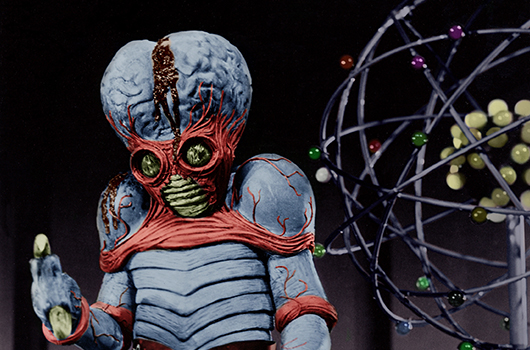
This Island Earth (Universal 1955)
Universal-International’s first science-fiction feature in full Technicolor, This Island Earth enjoyed its New York premiere on the 10th of June, 1955, ahead of a general release five days later. More than seventy years on, it stands as one of the most lavish and ambitious science-fiction films of its decade – and the picture that gave the world one of Universal’s last great monsters.
From pulp magazine to Technicolor spectacle
Like so many of the era’s finest science-fiction stories, This Island Earth began life on the page. It was adapted from the novel by Raymond F Jones, itself developed from a series of stories he had published in the science-fiction magazines of the late 1940s and turn of the 50s. The property found its way to producer William Alland, the man already steering Universal’s run of celebrated genre pictures, who recognised the chance to do something the studio’s monochrome monster movies never could: stage interplanetary war in vivid, eye-popping colour.
That ambition set the film apart from the outset. Where most 1950s science fiction was shot quickly and cheaply in black and white, This Island Earth was conceived as a prestige production – expensive, colourful and visually spectacular, with elaborate sets, matte paintings and optical effects intended to put genuine wonder on the screen.
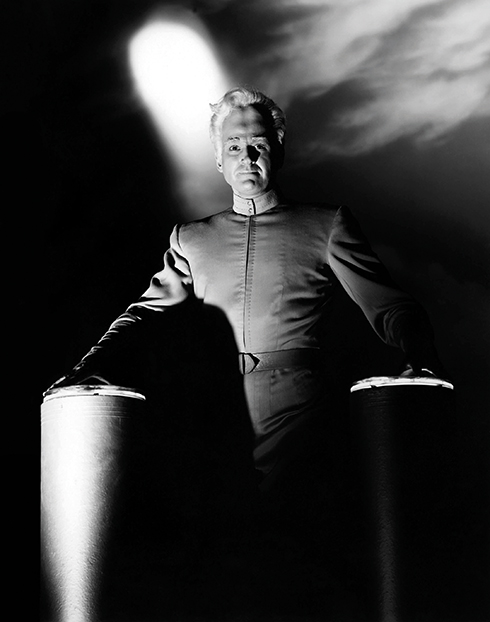
Jeff Morrow as the enigmatic alien Exeter, whose motivations are not what they initially seem.
The interocitor and a summons from the stars
The story opens with one of science fiction’s most memorable hooks. Scientist Dr Cal Meacham (Rex Reason) takes delivery of a mysterious catalogue of parts and is challenged to assemble them into a fiendishly complex device called the interocitor. When the machine flickers into life, a high-domed, white-haired stranger named Exeter (Jeff Morrow) appears on its triangular screen – and invites Meacham to join a secret think-tank of the world’s finest scientific minds.
There, alongside Dr Ruth Adams (Faith Domergue), Meacham slowly realises that nothing is as it seems. Exeter and his colleagues are not of this Earth at all, but emissaries of the planet Metaluna – a dying world being pounded relentlessly by its enemies, the Zagons, who guide blazing meteors down through its weakening defences. The scientists have been gathered to help save a civilisation light-years away.
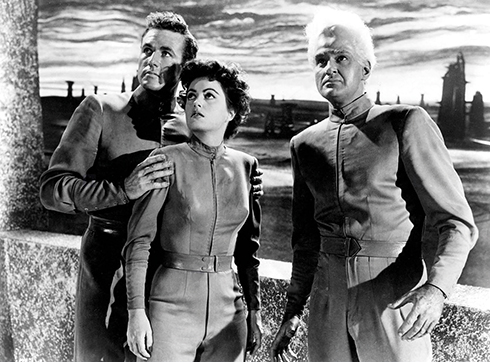
Dr Cal Meacham, Dr Ruth Adams and Exeter on the surface of the embattled planet Metaluna.
Joseph Newman, Jack Arnold and a vivid vision
Directed by Joseph M Newman and the celebrated Jack Arnold, This Island Earth drew on the talents of some of the studio’s most gifted craftspeople. Arnold – the man behind several of Universal’s defining 1950s monsters – is widely credited with shooting key sequences on Metaluna, lending those scenes their nightmarish intensity.
The film’s real star, though, was its look. The Technicolor photography turned Metaluna into a hellscape of green skies and molten rivers, while the spacecraft interiors and the planet’s bombarded surface gave audiences a scale of science-fiction spectacle they had rarely seen. In its day, the film was praised for what contemporary reviewers called “sensational” special effects and a “masterful” script – and the colour prints drew particular acclaim.
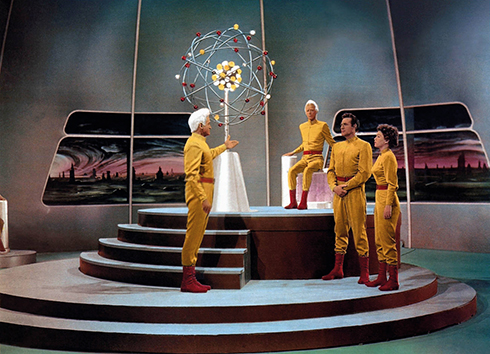
Exeter (Jeff Morrow), the Monitor (Douglas Spencer), Cal (Rex Reason) and Ruth (Faith Domergue) discuss the future of Metaluna.
A new Universal Monster: the Metaluna Mutant
For all its cosmic spectacle, This Island Earth is best remembered today for the creature that emerges in its final act. The Metaluna Mutant – with its bulging insect eyes, exposed brain, and great lobster-like claws – was designed by Universal’s famed make-up department under Bud Westmore, and it remains one of the most instantly recognisable monsters of the 1950s.
A servant species bred by the Metalunans, the Mutant became an icon almost the moment the film was released, its image splashed across posters and lobby cards. It earned its place alongside Universal’s classic gallery of monsters, and for many fans it is the single most enduring image the film left behind – proof that even in the atomic, outer-space age, the studio had not lost its gift for creating an unforgettable creature.
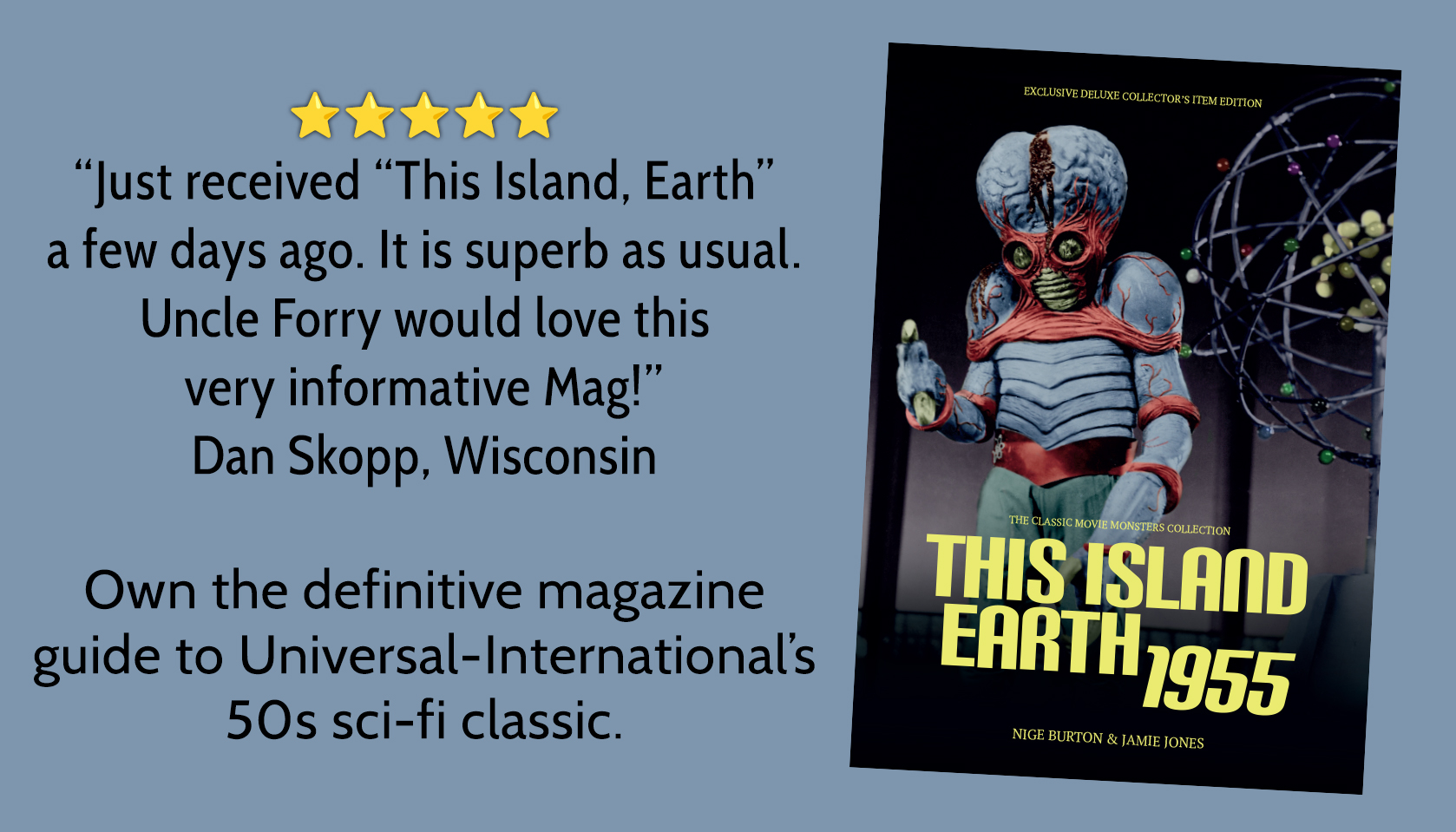
Get the Ultimate Guide in the shop →
Reception then and now
It is worth remembering how well regarded This Island Earth was on release. Critics admired its effects, its colour and its intelligence, and it helped legitimise science fiction as a genre capable of genuine spectacle and ideas. In later decades its reputation dipped – it was affectionately ribbed by a younger generation, most famously as the feature riffed in Mystery Science Theater 3000: The Movie (1996) – yet even that backhanded attention only confirmed its enduring fame.
Reappraisal has been kind. Today This Island Earth is once again widely regarded as one of the finest science-fiction films of its era, admired for its ambition, its visual splendour and its unforgettable monster. For anyone exploring the golden age of 1950s science fiction, it remains essential – a Technicolor voyage to a dying world, and the birthplace of the mighty Metaluna Mutant.
Our This Island Earth 1955 Ultimate Guide Magazine tells the full story of the film across 36 beautiful full-colour pages – production history, cast and crew biographies, and a wealth of beautifully restored stills. Get your copy in the shop →
This definitely deserves a spot among the great classic sci-fi flicks of the 1950s. The story and special effects (in the pre-CGI era) make it a worthy addition when considered in the context of that decade. A friend of mine had the great fortune to meet with Jeff Morrow and his wife a few years before Morrow’s passing in 1993. Morrow mentioned how much he enjoyed this movie (his first venture into sci-fi) and being remembered for his role in it.
They need to go back and make movies like this again, and not use that fake looking CGI. This Island Earth stands as an example of when you have a good story, Good acting and great special effects. They definitely do not make films like this anymore.
Saw this flick in my jammies at the drive-in movies. Made a big impression on me, as well as some famous movie producers. You’ll see this guy on a television set in the background of at least one major sci-fi movie.
Still one of my faves