





Facing the Fear
Marcus Hearn’s new exhibition asks why we just can’t resist a good scare
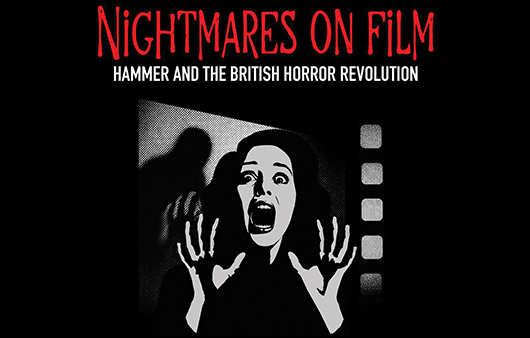
Why do we love being scared? It’s a question that has kept nervous cinemagoers clutching their armrests for generations, and it sits at the heart of Nightmares on Film: Hammer and the British Horror Revolution, a terrific new exhibition at Peterborough Museum & Art Gallery. Running until the 6th of February, 2027, it argues that British horror films have never simply been about making us jump. They have given us a safe place to stare our darkest fears in the face – and perhaps even to understand them.
The exhibition has been curated by our good friend and colleague Marcus Hearn, and it’s hard to imagine anyone better suited to the job. Marcus is one of the most respected film and cultural historians working today. He co-wrote The Hammer Story, the authorised history of the studio, has penned the official biographies of George Lucas and Gerry Anderson, and is an associate research fellow at De Montfort University’s Cinema and Television History Research Centre. He has curated exhibitions at London’s Barbican and makes award-winning documentaries, too. But here’s the thing – beneath all that scholarly expertise beats the heart of a lifelong horror fan. Marcus doesn’t just know why these films matter; he adores them. It’s the best of both worlds: the rigour of a historian and the passion of someone who would happily queue round the block for a late-night double bill.
The story begins in the early 1950s, shortly after the British Board of Film Censors introduced the X certificate. One of the first British films to earn it was Cosh Boy (1953), a juvenile delinquent drama starring a young Joan Collins, which tapped into a very contemporary panic about teenage tearaways running riot on the streets. Hammer, meanwhile, was finding its feet with science fiction. The Quatermass Xperiment (1955) – its title cheekily trumpeting the new certificate – followed by X the Unknown (1956) and Quatermass 2 (1957), turned Cold War jitters about radiation, alien invasion and faceless officialdom into box-office gold. But the real game-changer was still to come. Hammer took the old Universal monsters, splashed them with lurid colour and unleashed The Curse of Frankenstein (1957) on a country still shaking off post-war austerity. Audiences queued in their thousands, critics reached for the smelling salts, and a buttoned-up Britain discovered that it rather enjoyed a little Gothic excess with its Saturday night fish supper.
What made those films so potent? The exhibition suggests they gave shape to anxieties people couldn’t easily voice – about science run amok in the atomic age, about desire and repression, and about an old order clinging on while the world changed around it. Isn’t that what all the best monsters do? They let us look at the things that frighten us from the relative safety of the back row.
By 1960, horror was turning its gaze inward. Michael Powell’s Peeping Tom and Alfred Hitchcock’s Psycho – the latter made in Hollywood by Leytonstone’s most famous export – swapped castles and capes for the quiet young man next door. The monster now looked just like us, which was far more unsettling. Peeping Tom caused such a furore that it badly damaged Powell’s career, with Derek Hill of the Tribune declaring that “the only really satisfactory way to dispose of Peeping Tom would be to shovel it up and flush it swiftly down the nearest sewer. Even then, the stench would remain.” Today it’s rightly hailed as a masterpiece – proof that the films that frighten us most are often the ones holding up a mirror.
Then came Amicus, Hammer’s cheeky rival, whose portmanteau films such as Dr Terror’s House of Horrors (1965) served up fear in bite-sized portions, like a sinister box of chocolates in which every one has a nasty surprise in the middle. And as the swinging sixties lost their swing and gave way to the seventies, British horror left the city behind and headed out into the fields. Witchfinder General (1968), Blood on Satan’s Claw (1971) and The Wicker Man (1973) – the unholy trinity of folk horror – tapped into something older and stranger: the creeping suspicion that beneath England’s green and pleasant land lay something pagan, cruel and waiting. Who among us hasn’t eyed a village fete a little warily since?
The exhibition also charts how audiences and censors responded to each new shock, from the censors’ scissors to the outrage of the press, as each generation of filmmakers pushed at the limits of what Britain would tolerate. It’s all told through a veritable treasure trove of rare posters, unique costumes and behind-the-scenes artefacts from Hammer and the other studios that shaped the genre – enough to leave any collector weak at the knees.
There’s a terrific programme of screenings and talks running alongside it, too. On the 21st of November, 2026, Marcus gives a curator’s talk revealing the research behind the exhibition, followed that evening by the UK premiere of his documentary Hammer and Beyond: The Jimmy Sangster Legacy. Hammer favourite Madeline Smith joins him in conversation on the 16th of January, 2027, ahead of a screening of Frankenstein and the Monster From Hell (1974), while the wonderful Caroline Munro closes the season on the 6th of February, 2027, alongside Captain Kronos Vampire Hunter (1974).
So, why do we love being scared? Perhaps because facing our fears in the dark, surrounded by fellow sufferers, is how we learn that we can survive them. Go along and decide for yourself – tickets are just £5 for adults and £3 for under-16s, plus a booking fee. Book now at https://peterboroughmuseum.org.uk/events/nightmares-on-film
Leave a comment